skip to main |
skip to sidebar
They're a lot of critters in Caliban's End. Some are wildly fantastical like the Cabal, a group of arse-kicking monsters. I finished Chapter 8 last week, the climax of which is a fight with one of the Cabal - big ugly bugger called Katcochila. This creature is a little bit like a half-deflated hot air balloon. He has countless legs which struggle to move his fat body around. Katcochila has a few other quirks. He has no skin. His stomach lies on the outside of his body which is rather unpleasant for anyone who falls onto it. He also has a long thin neck with a tiny head at the end of it. Many of my monsters are quirky and hopefully a little bit disturbing. I didn't want to go for archetypal monsters. I want the reader to have the same sense of incredulity as our heroes have when they come across these behemoths for the first time.
This week I also created Puddy who is currently my favourite character which, I admit, is something that changes every week! (MINOR SPOILER ALERT) Poor Puddy doesn't stay in the story for long, but I think I managed to infuse him with plenty of character for his brief stay. He's a huge flying lobstery thing, is very childlike, a bit of a sook, but wonderfully loyal. He's basically a big blue puppy with a hard shell. We meet him in Chapter 7 which I should finish tonight if I have a few cups of coffee.
It's probably worth commenting upon something whilst we're talking about critters. I have a bit of a challenge in this book - I can't refer to any animals in our world. Doing so would break the suspension of disbelief as there are no horses, or dogs, or cats, or lions, tigers and bears in Terra. All the creatures of Caliban's End are unique to the novel. So why's that a challenge? Well, I am quickly discovering how bloody hard it is to avoid animal metaphors and similes. If I have a crab-like creature I can't describe it as having "claws like a crab". That would be too jarring. Perhaps I could emply a word like 'crancriform' instead (which is a word I do like), but this makes the novel a little inaccessible to some. Luckily, they more I write, they more techniques I discover to get around problems like this.
The first technique is to use the sound of familiar words to evoke a sense of a made-up creature's design. For example, Puddy is a lobbsle. Hopefully that conjures images of lobsters because Puddy looks a bit like a crustacean. I have used this simple technique quite a bit. In the novel I have shelps (which are like sheep), snorses (which is kind of a cross between a horse, a snail and a taun-taun from The Empire Strikes Back), squirls, turtla and gillygulls, to name a few. It's turning out to be quite a menagarie. I may have to add a bestiary page to my Caliban's End wiki (http://calibansend.pbwiki.com/).
Another technique is to use a sound that evokes something of a creature's nature. For example, in the book you'll meet some grizzum which are melancholy, stubborn beasts of burden. The look a bit like a cross between a bear and a yak (that is if bears and yaks were ever predisposed to mate). I think the name grizzum creates a sense of the creature's grumpy and recalcitrant nature. Similarly, marroks are nasty, cunning beasts and for some reason I can get a feeling of this from their name. One of my favourite animals is a bird called a quawk. It's an ugly, vindictive bird. Out of pure spite, a flock of quawks will shit on any unwary people below. They even do it high above fierce battles. Fortunately the act of defecation is painful for these avian menaces, so they release an ear-piercing shriek just before dumping on their victims. Soldiers have been known to momentarily cease hostilities just to avoid this beast's vindicative noisome deposits.
The last technique I utilise to escape the need to use traditional animal imagery is to focus upon a creature's characteristics to suggest what sort of animal he/she/it resembles. For example, Puddy is a lot like a goofy labrador, so describing him in a way that would also befit a labrador is a way of bringing a little more clarity and definition to this fictional beast.
I am also enjoying placing a twist on conventional and cliched metaphors by using the creatures of Terra to describe people in the book. Phrases like 'cunning as a marrok' or 'as proud as a staggorn' are becoming quite prevalent in the book. Note to self: take care not to overdo this.
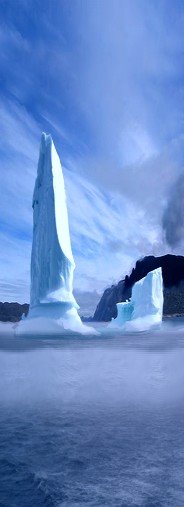
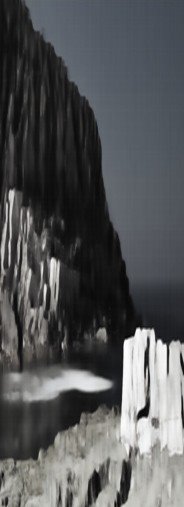
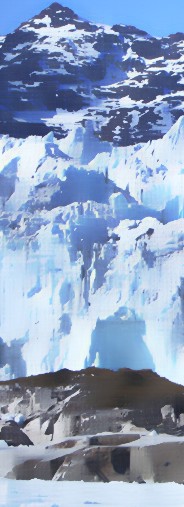
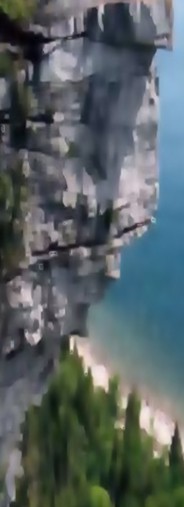
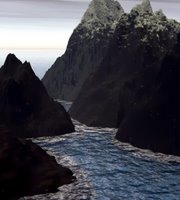 Lastly, on a totally unrelated matter, I installed Vue on my laptop today. It's basically 3D rendering software. I've used it once before for a couple of hours and you can get pretty good results from just a little bit of effort. I plan to use it heaps in the year to come. The past few days have seen me writing about Lara Brand's journey up an unnamed peninsula to the Isle of Grisandole so today during my lunchbreak I did a quick picture of Grisandole. It's not brilliant but for 45 minutes' work, it's not bad.
I'm going to sneak downstairs and have the chocolate Drumstick that's sitting in the fridge and then I'm going to finish Chapter 7 before midnight swings around.
Cheers, Paul
 I moved onto the second draft of Chapter Eight this week. I haven't quite finished polishing Chapter Seven, but it's almost done and I wanted to write some action.I really like this chapter. I think the main reason for that is it introduces one of my favourite characters - the stoic Pylos. He's really the novel's hero. I have literally fashioned him in the likeness of a Greek hero. Helyas is quite obviously a tribute to the heroes of Greek literature (or in my case Ray Harryhausen films). Although Pylos is your quintessential brave warrior, I think I've avoided stereotypes by adding a few character flaws that become more evident as the book goes on. In terms of Greek literature, he isn't as arrogant as Achilles, and whilst he is perceptive and a good reader of people and situations, he isn't as shrewd as Odysseus or Jason. Nor is a classically handsome youth, the sort the gods would fall in love with. He is neither tall nor beautiful.The chapter opens with Pylos, the General of Helyas' armies standing before a Senate asking for more money - I haven't yet worked out a currency on Terra - to fund the military's expenses. I go to great pains to highlight the decadence of this particular Senate. Here I fuse the Roman with the Greek and as i wrote images of Caligula and Nero came to mind.I think I got this bit right. Rather than spend half the chapter extolling Pylos' virtues, I thought I'd put him in a situation where he faced of against cretinous, petty bureaucrats and this would help the reader to grow fond of the hero. I thought it would be interesting to place the hero in a context that was totally incongrous with his strengths and the halls of politics seemed a good choice. Without giving too much away, the Senate refuse to grant Pylos his request and tell him instead that they intend to mothball the military (yes, traces of Star Trek VI: The Undiscovered Country). The rest of the chapter is devoted to the Ghul attack upon Sulis which is deliberately juxtaposed with the Senate scene to highlight the poor decision the senators were prepared to make. In this day and age, the chapter could be read as a pro-military piece, but it certainly isn't written as one. If anything, the chapter is anti-authority and by the end of it, the reader should feel nothing but contempt for the rulers of Sulis. But the focus of the chapter is the individual, and it is more important to me that the reader identifies with Pylos than any secondary socio-political aspects that help drive the narrative forward.I found this a very easy chapter to write. In a few places I have allowed my dry sense of humour to creep in, evident in numerous secondary and tertiary characters, my favourite being the nervous Captain of the Guard, Quintinius. The structure is clean and I think it concludes well with a number of elements introduced early in the chapter having a significant role in the end. I can see this habit of reintroducing elements in the narrative as being a stylistic bent of mine. It's not surprising - it's a cinematic trait and I love my movies.Perhaps the biggest influences upon this chapter is an old Avengers comic I read when I was a kid. I don't know what issue it was (no doubt I will be told one days and much kudos to the one who tells me) but the story was basically this: the US Congress (I think it was them) tries to register America's superheroes and limit the number of heroes on the Avengers roster. The outspoken Peter Gyrich, a suit with a lot of attitude (much like Senator Leippa in my tale) almost gets his way to restrict the superheroes' freedom to act, but when the courthouse is attacked, he has to admit that America needs its superheroes. The Beast (of X-Men fame) hands a humbled Gyrich a piece of would so he can fight off "the big bad monster" (I think this quote is correct - I last read the comic over twenty-five years ago) before the heroes step in to win the fight. It's a lovely piece of writing and I can still see John Byrne's superlative art in my mind's eye. For some reason, this issue resonated with me, so its seems the perfect influence to introduce the novel's most heroic character.It's 10:10 on a Friday night. My family are all asleep. I think I'll get a coffee and write some more of the novel now.
 Lastly, on a totally unrelated matter, I installed Vue on my laptop today. It's basically 3D rendering software. I've used it once before for a couple of hours and you can get pretty good results from just a little bit of effort. I plan to use it heaps in the year to come. The past few days have seen me writing about Lara Brand's journey up an unnamed peninsula to the Isle of Grisandole so today during my lunchbreak I did a quick picture of Grisandole. It's not brilliant but for 45 minutes' work, it's not bad.